
East Africa & Global Opportunities

Your gateway to global opportunities

Discover scholarships, jobs, fellowships, internships and trainings from around the world.
Jobs, Tenders & Trainings

Build your career with confidence

Explore vacancies, tenders, internships and trainings from NGOs, institutions and international organizations.
Popular: Scholarships Fellowships Jobs Tenders Trainings Internships
100,000+Daily Views
9,000,000+Views in 3 Months
46,000+Community Followers

INTRODUCTION TO PROJECT PLANNING AND MANAGEMENT

INTRODUCTION TO PROJECT PLANNING AND MANAGEMENT

Uncategorized
Wishlist Share

About Course

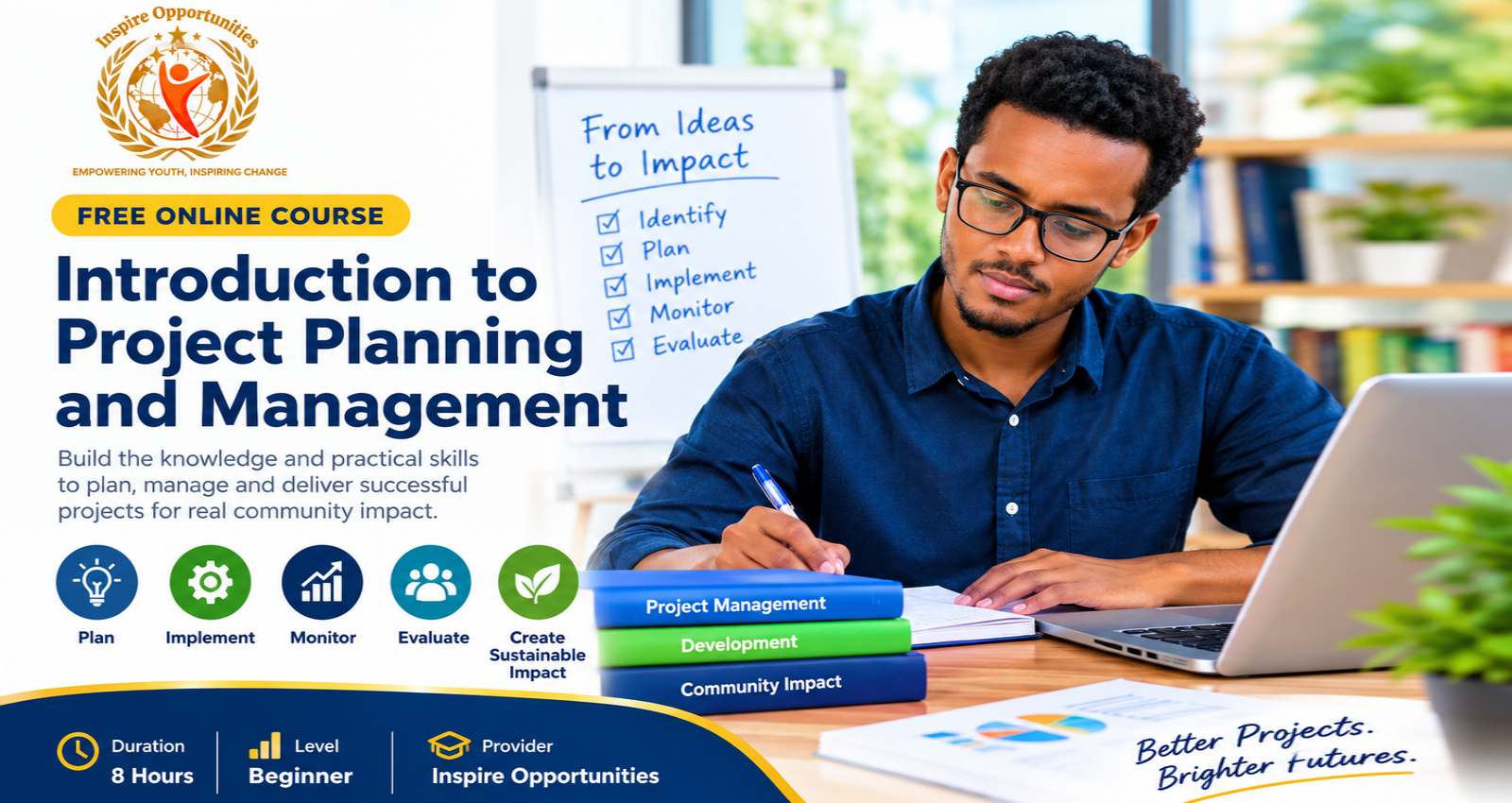
Projects play an essential role in addressing social, economic, humanitarian and development challenges. However, successful projects require more than good ideas. They need proper identification, planning, budgeting, implementation, monitoring and evaluation.

This course introduces learners to the fundamental principles and practical tools of project planning and management. It explores the project life cycle, needs assessment, project design, proposal development, budgeting, implementation, monitoring, evaluation, accountability and sustainability.

Through practical examples, exercises and assessments, participants will develop an understanding of how to transform an idea into a structured project that responds to real needs and delivers measurable results.

The course is particularly relevant to individuals interested in humanitarian assistance, international development, community development, civil society, NGOs and public-sector programmes.

Show More

What Will You Learn?

  • By the end of this course, you will be able to:
  • 1. Understand the fundamental principles of project planning and management.
  • 2. Explain the five stages of the project management life cycle.
  • 3. Identify community needs and conduct basic needs assessments.
  • 4. Apply Problem Tree Analysis to identify problems, causes and consequences.
  • 5. Conduct basic stakeholder analysis.
  • 6. Develop SMART project goals and objectives.
  • 7. Prepare project concept notes and structured project proposals.
  • 8. Understand and apply the Logical Framework Approach (Logframe).
  • 9. Prepare basic project budgets and estimate implementation costs.
  • 10. Understand financial accountability and responsible resource management.
  • 11. Develop project implementation plans and activity schedules.
  • 12. Coordinate project teams and manage implementation challenges.
  • 13. Identify project risks and develop appropriate mitigation measures.
  • 14. Understand monitoring, evaluation, accountability and learning (MEAL).
  • 15. Develop project indicators and identify appropriate data collection methods.
  • 16. Prepare project progress reports and document achievements.
  • 17. Understand project sustainability, closure and lessons learned.
  • 18. Develop a basic project concept addressing a real community development challenge.

Course Content

MODULE 1: INTRODUCTION TO PROJECT MANAGEMENT
Understand the foundations of project management, the characteristics of projects and the responsibilities involved in managing projects successfully.

  • Lesson 1.1: Understanding Projects and Project Management
  • Lesson 1.2: The Project Life Cycle
  • Practical Example
  • Learning Outcomes
  • An organization identifies unemployment among young people as a major community challenge.

MODULE 2: PROJECT IDENTIFICATION AND NEEDS ASSESSMENT
Learn how to identify community needs, understand problems and establish a clear justification for project interventions.

MODULE 3: PROJECT DESIGN AND PROPOSAL DEVELOPMENT
Learn how to transform an identified problem into a structured project with clear objectives, expected results, activities and measurable indicators.

MODULE 4: PROJECT BUDGETING AND RESOURCE MANAGEMENT
Understand how project budgets are developed, resources are allocated and financial resources are managed responsibly.

MODULE 5: PROJECT IMPLEMENTATION AND COORDINATION
Understand how project activities are organized, coordinated and delivered according to approved plans.

MODULE 6: MONITORING, EVALUATION, ACCOUNTABILITY AND LEARNING (MEAL)
Explore how projects measure progress, assess results, maintain accountability and use evidence to improve programme performance.

MODULE 7: PROJECT REPORTING AND SUSTAINABILITY
Learn how to communicate project progress, document achievements and plan for the continuation of project benefits beyond the funding period.

MODULE 8: PRACTICAL PROJECT DEVELOPMENT AND FINAL ASSESSMENT
Apply the knowledge acquired throughout the course to develop a basic project concept and demonstrate understanding of the project management cycle.

FINAL COURSE COMPLETION
By the end of this course, learners should have a foundational understanding of project planning and management and be able to contribute more effectively to the development, implementation and monitoring of community, humanitarian and development projects.Course Completion Requirements • Complete all eight modules. • Review the learning materials. • Participate in the module activities. • Complete the final assessment. • Meet the course passing requirement.

Student Ratings & Reviews

No Review Yet
No Review Yet